 Tamil Nadu
 Karnataka
 Kerala

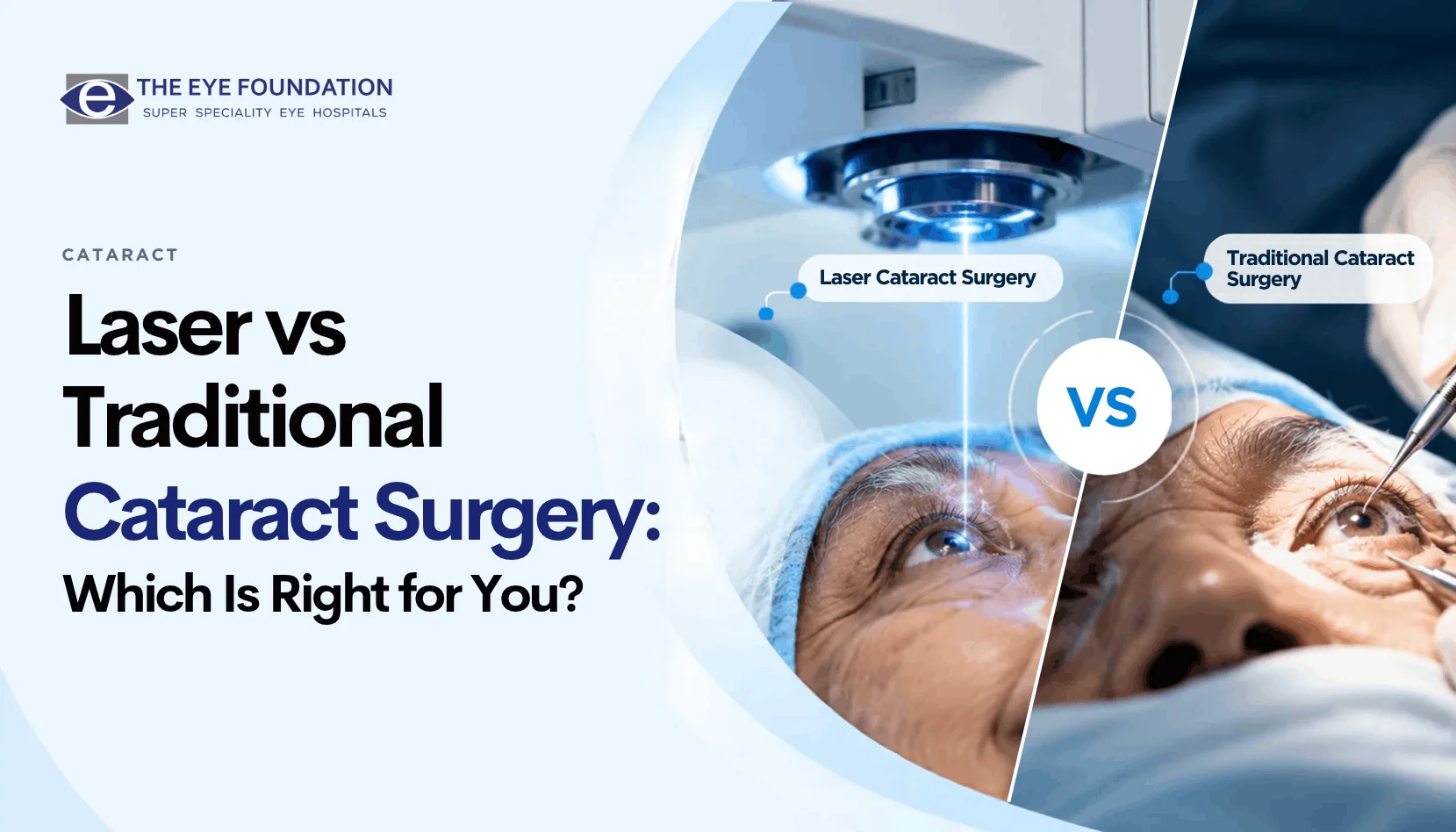
Laser vs Traditional Cataract Surgery: The Question Every Patient Asks
"Should I go for laser or normal surgery?"
If you've been told you need cataract surgery, chances are you've asked this too. Maybe a relative in Chennai had "laser" surgery and swears by it. Maybe a friend had traditional surgery ten years ago and still sees perfectly. And now you're stuck in the middle, wondering which one is right for you.
Here's the good news: when it comes to laser vs traditional cataract surgery, there's no wrong choice. Both are safe, both are quick, and both can give you clear vision again. The real question is which one suits your eyes, your lens choice and your budget.
Let's break it down in simple words.
First, What Actually Happens in Cataract Surgery?
Think of the natural lens in your eye like a camera lens. Over the years, it slowly turns cloudy, like a foggy window. That cloudiness is a cataract. You'll notice blurry vision, glare from headlights, or colours that look dull and yellowish.
Cataract surgery simply removes that foggy lens and puts in a clear artificial one, called an intraocular lens (IOL). It stays in your eye for life.
Every cataract surgery, laser or traditional, follows three steps:
- A tiny opening is made in the front of the eye
- The thin bag holding the lens is opened and the cataract is broken up
- The cataract is removed and the new lens is placed in
The only real difference in laser vs traditional cataract surgery is how the first two steps are done.
Traditional Cataract Surgery (Phaco and MICS): Tried, Tested and Trusted
Traditional cataract surgery is called phacoemulsification, or simply "phaco". It's the most commonly done eye surgery in the world, and for good reason.
Here's how it works. Your surgeon makes a tiny cut, about 2–2.8 mm, using a fine blade. They gently open the lens bag by hand. Then a small ultrasound probe breaks the cataract into tiny pieces and suctions them out. The foldable new lens slides in through the same small opening.
In MICS (Micro Incision Cataract Surgery), the opening is even smaller, often under 2 mm. No stitches. No injection. Just numbing eye drops.
Why patients choose traditional cataract surgery:
- Decades of proven safety and excellent results
- Takes only 10–20 minutes per eye
- Costs less than laser cataract surgery
- Usually fully covered by health insurance
- In experienced hands, results are outstanding
Laser Cataract Surgery (FLACS): Precision With a Computer's Help
Laser cataract surgery is technically called femtosecond laser-assisted cataract surgery (FLACS). You may also hear it called "bladeless" or "robotic" cataract surgery.
First, a 3D scanner maps your eye in detail. Then a laser makes the tiny openings, cuts a perfectly round opening in the lens bag, and softens the cataract. After that, your surgeon takes over, removes the softened cataract with a phaco probe, and places the new lens.
So, laser doesn't replace your surgeon. It just handles a few early steps with computer-guided precision.
Why some patients choose laser cataract surgery:
- Very precise, consistent openings every time
- Less ultrasound energy, which can be gentler on delicate corneas
- Can correct mild astigmatism during the same surgery
- Helps position premium lenses (multifocal, toric, EDOF) very accurately

What you should also know:
- It costs more than traditional surgery
- It isn't suitable for every eye, such as very small pupils or some corneal conditions
- It adds a few minutes to the procedure
- Large studies show that for most people, final vision is about the same with laser and traditional surgery
Laser vs Traditional Cataract Surgery: A Quick Comparison
| Factor | Traditional (Phaco / MICS) | Laser (FLACS) |
|---|---|---|
| Opening made by | Surgeon, with a fine blade | Computer-guided laser |
| Lens bag opening | By hand | Laser, perfectly round |
| Cataract break-up | Ultrasound | Laser softening + less ultrasound |
| Time per eye | 10–20 min | 15–30 min |
| Pain | None (numbing drops) | None (numbing drops) |
| Back to routine | 1–2 days | 1–2 days |
| Astigmatism correction | Toric lens | Toric lens or laser |
| Final vision | Excellent | Excellent, similar for most |
| Cost | Lower | Higher |
| Insurance | Usually covered | Laser part may not be fully covered |
So, Which Cataract Surgery Is Right for You?
Let's make it practical.
Traditional phaco or MICS is a great fit if you:
- Have a routine cataract with no other major eye problems
- Are choosing a standard monofocal lens
- Want a proven, budget-friendly option that insurance covers fully
Laser cataract surgery may be worth it if you:
- Are choosing a premium lens like multifocal, trifocal, EDOF or toric
- Have mild to moderate astigmatism
- Have a very hard, dense cataract or a weak cornea
- Want maximum precision in lens positioning
Honestly, the machine matters less than two things: a thorough eye check-up before surgery and an experienced cataract surgeon. A good surgeon will check your cornea, retina, pupil size and lens measurements, and then tell you plainly which option makes sense.
Cataract Surgery Cost in Chennai: What Changes the Price?
The cost of cataract surgery in Chennai depends on a few things:
- Type of surgery: traditional phaco/MICS or laser cataract surgery
- Lens you choose: monofocal, toric, multifocal, trifocal or EDOF
- Your eye health: diabetes, glaucoma or a past eye surgery may need extra care
- Insurance: most policies cover cataract surgery, but check your limit for premium lenses and laser
At The Eye Foundation, you'll get a clear, written estimate after your eye evaluation. No surprises.
Choosing the Best Lens for Cataract Surgery
Your lens choice often matters more than laser vs traditional. Here's a quick guide:
- Monofocal: clear distance vision; you'll still need reading glasses
- Toric: corrects astigmatism along with cataract
- Multifocal / trifocal: reduces dependence on glasses for near, intermediate and distance
- EDOF: smooth vision from distance to computer range, with fewer halos
Your surgeon will help you pick the best lens for cataract surgery based on your lifestyle, whether you drive at night, read a lot or work on screens.
Recovery: Same for Both, Quick for Most
Whether you choose laser or traditional cataract surgery, recovery looks much the same:
- Vision usually improves within a day or two
- Eye drops for about 3–4 weeks
- No rubbing, swimming or heavy lifting for 2–3 weeks
- Eye shield at night for the first week
- Follow-ups on day 1, week 1 and month 1
When you compare laser vs traditional cataract surgery, both can give you sharp, clear vision. Traditional phaco and MICS are proven and affordable. Laser adds precision that can help with premium lenses and astigmatism. The best choice is the one your surgeon recommends after a proper eye check-up.
Book Your Cataract Consultation in Chennai
Still not sure which cataract surgery in Chennai is right for you? Talk to our cataract specialists at The Eye Foundation, Vadapalani. We offer [traditional phaco, MICS and laser-assisted options: confirm with TEF] with a full range of premium lenses, and we'll help you choose what fits your eyes, lifestyle and budget.
Frequently Asked Questions
1. Laser vs traditional cataract surgery: which is better?
Both are safe and give excellent vision. Laser offers more consistent precision in a few steps, but for most patients the final result is similar. Your eye condition and lens choice decide what's best for you.
2. Is laser cataract surgery painful?
Not at all. Both laser and traditional surgery use numbing eye drops. You may feel slight pressure, nothing more.
3. Is robotic cataract surgery the same as laser cataract surgery?
Yes, mostly. "Robotic" and "bladeless" are other names for femtosecond laser-assisted cataract surgery. Your surgeon is still in control.
4. How long does laser cataract surgery take?
Around 15–30 minutes per eye. You go home the same day.
5. Does insurance cover laser cataract surgery in Chennai?
Most insurance covers cataract surgery. The extra laser charge or premium lens may not be fully covered, so check with your insurer and our billing team.
6. Can both eyes be done on the same day?
Usually not. Each eye is done separately, a few days to weeks apart, so the first eye heals well.