 Tamil Nadu
 Karnataka
 Kerala

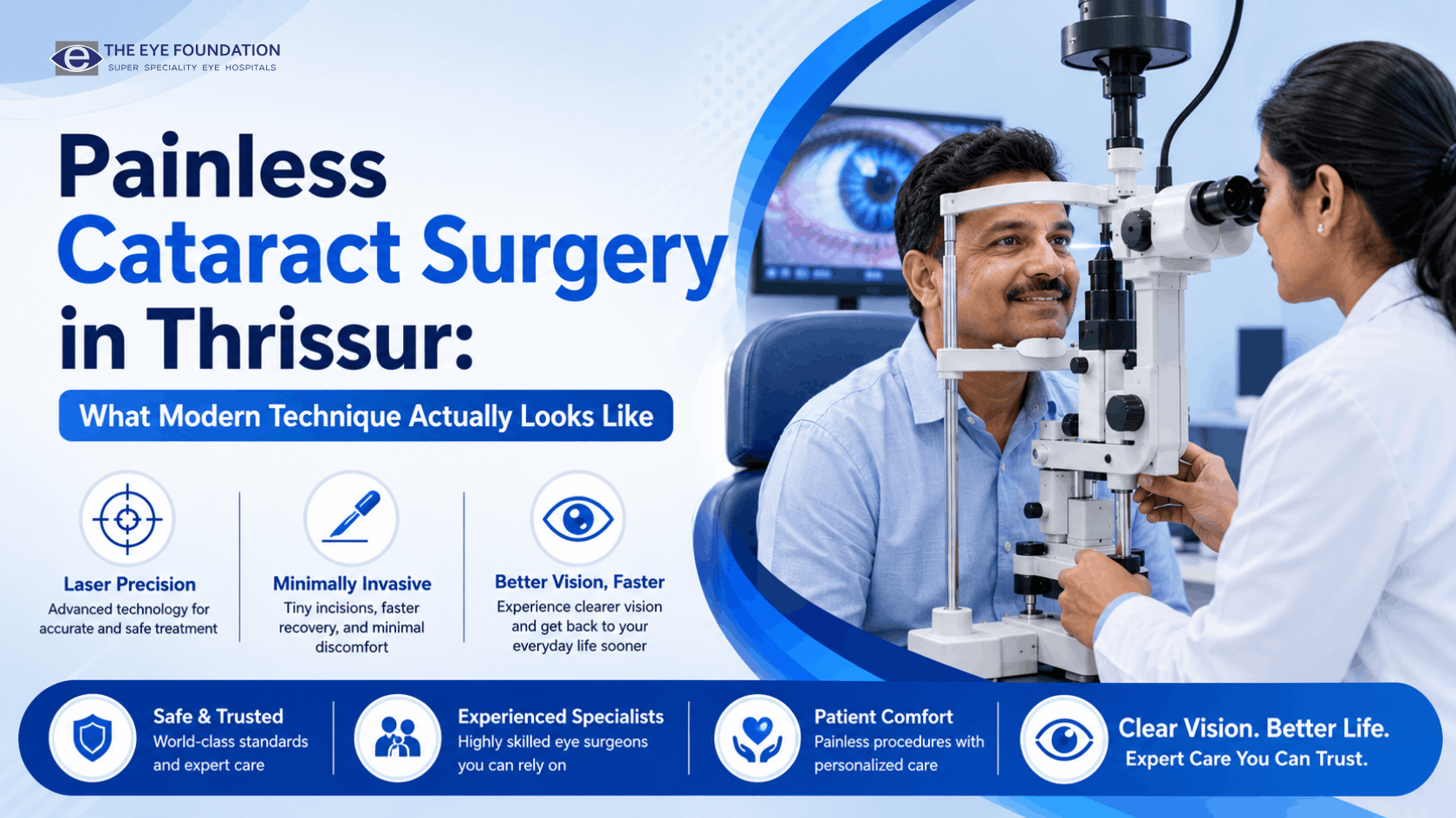
Cataracts are one of the most common reasons people over 50 start noticing changes in their vision colors seeming duller, night driving becoming harder, or reading requiring more light than it used to. The word "surgery" understandably makes people anxious, but painless cataract surgery in Thrissur has genuinely become the standard of care today, not an exception reserved for a lucky few, and The Eye Foundation's Thrissur branch has been at the centre of that shift for local patients.
Understanding What a Cataract Actually Is
A cataract is a gradual clouding of the eye's natural lens, which sits behind the iris and normally focuses light onto the retina. Over time usually due to age-related protein changes in the lens, though diabetes, prolonged steroid use, smoking, and excessive UV exposure can accelerate the process this lens becomes progressively cloudy, scattering light rather than focusing it clearly. The result is blurry vision, glare sensitivity, faded colors, and difficulty seeing in low light, all of which tend to develop slowly enough that patients often don't realize how much their vision has declined until it's assessed properly.

Why "Painless" Isn't an Exaggeration Anymore
Painless cataract surgery in Thrissur today typically uses a technique called phacoemulsification, where a tiny incision usually under 3mm is made at the edge of the cornea, and ultrasound energy is used to break up the cloudy lens into fragments that are gently suctioned out. An artificial intraocular lens (IOL) is then folded and inserted through the same tiny incision, unfolding into place inside the eye. The entire procedure typically takes 15-20 minutes and is done under topical or local anaesthesia meaning the eye is numbed with drops rather than requiring injections in most straightforward cases.
Because the incision is so small, it's usually self-sealing, requiring no stitches in most cases, which significantly reduces post-operative discomfort compared to older surgical techniques that required larger incisions and sutures. Most patients describe feeling only mild pressure during the procedure rather than genuine pain, and any post-operative discomfort is typically limited to mild grittiness for a day or two.
Femtosecond Laser-Assisted Options
For patients seeking an even more precise approach, femtosecond laser-assisted cataract surgery has become available at more advanced centres, using laser technology to perform the initial incision and lens fragmentation with computer-guided precision rather than manual technique alone. This can offer particular benefits for patients with astigmatism or more complex cataracts, though standard phacoemulsification remains excellent for the vast majority of routine cases.
Choosing the Right Intraocular Lens
One of the more important decisions in painless cataract surgery in Thrissur isn't about the surgery technique itself, but about which artificial lens replaces the natural one. Standard monofocal lenses provide clear vision at one distance (usually far), meaning reading glasses are still typically needed afterward. Multifocal and extended depth-of-focus lenses, on the other hand, are designed to reduce dependence on glasses for both near and far vision, though they come with their own trade-offs, like occasional glare or halos, particularly noticeable at night. Toric lenses are specifically designed for patients with significant astigmatism.
A good surgeon at The Eye Foundation takes time to discuss lifestyle needs whether you read frequently, drive at night often, or work on computers extensively before recommending the most suitable lens option, rather than defaulting to a one-size-fits-all recommendation.
What Recovery Actually Looks Like
Recovery from painless cataract surgery in Thrissur is typically remarkably quick by surgical standards. Most patients notice improved vision within 24 to 48 hours, though full stabilization of vision can take a couple of weeks as the eye heals completely. Eye drops are prescribed for a few weeks afterward to prevent infection and control inflammation, and patients are generally advised to avoid heavy lifting, swimming, and eye rubbing during the initial healing period.
Follow-up visits, typically at one day, one week, and one month post-surgery, allow The Eye Foundation's surgical team to monitor healing and address any concerns promptly. Complications are relatively rare with modern technique, though they're not impossible, which is exactly why consistent follow-up matters as much as the surgery itself.
Who Should Consider Surgery, and When
Cataract surgery is generally recommended once the cataract starts meaningfully interfering with daily activities difficulty driving, reading, or recognizing faces at a distance rather than waiting for the cataract to become "ripe," an outdated concept from older surgical eras. Modern technique means there's little benefit to delaying surgery once it's genuinely affecting quality of life.
Taking the Next Step
If cataracts are starting to affect your daily life, a proper evaluation is the right next step. Painless cataract surgery in Thrissur at The Eye Foundation has genuinely transformed what used to be a feared procedure into a quick, comfortable, day-care experience with fast recovery and excellent visual outcomes for the vast majority of patients.