 Tamil Nadu
 Karnataka
 Kerala

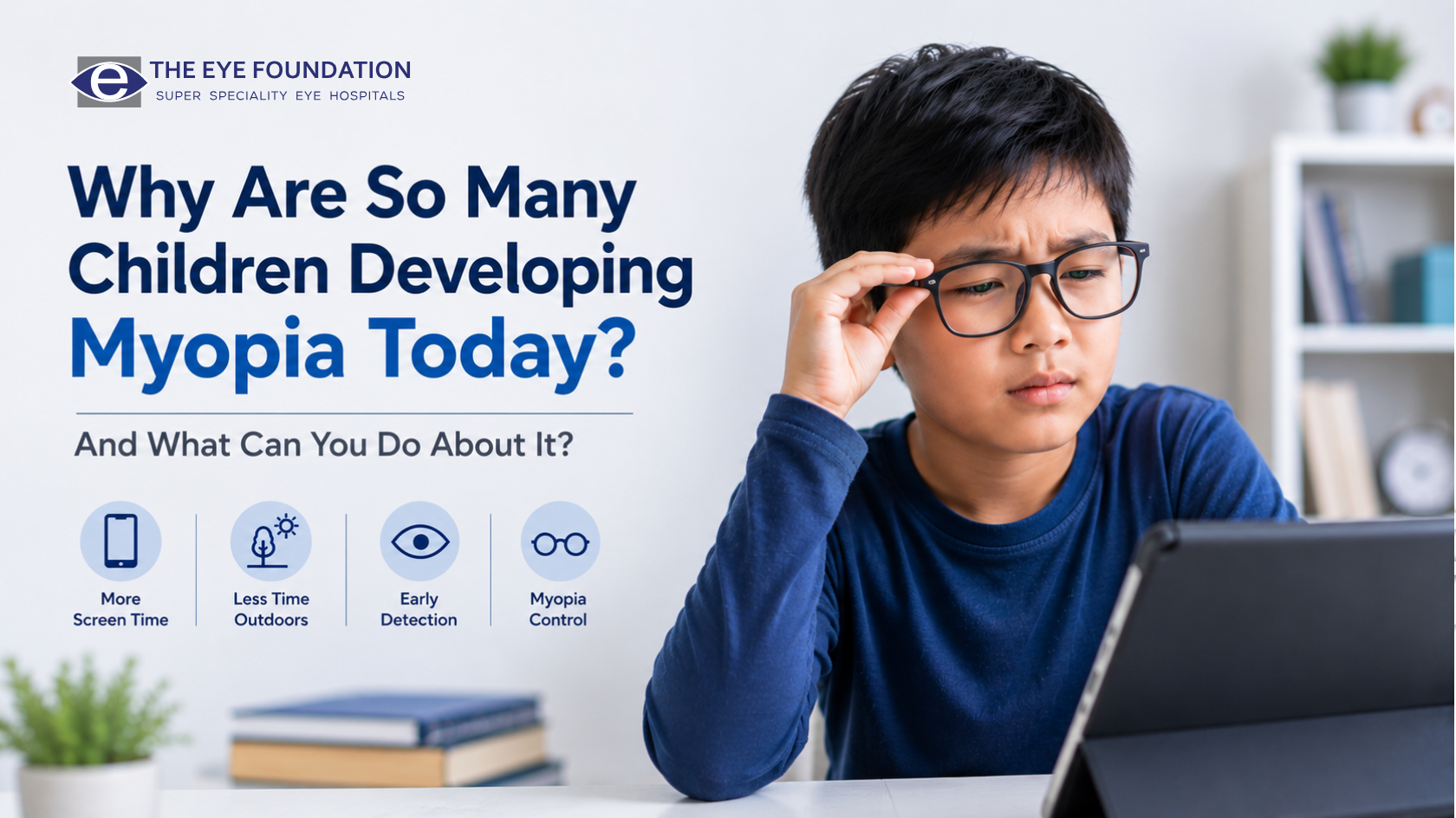
If your child is squinting at the board in school or sitting too close to the television, don’t dismiss it as a habit. It could be the first sign of Myopia in children, one of the most rapidly growing eye conditions we see at The Eye Foundation today.
Myopia in children (short-sightedness) affects a child’s ability to see distant objects clearly, while near vision remains fine. The numbers are rising sharply, and increased screen time is a big part of the story.
The good news is that with early detection and the right care, Myopia in children is very manageable. Here’s everything you need to know as a parent.
Why Is Myopia Becoming So Common in Children?
A generation ago, children spent most of their day outdoors. Today, between online classes, tablets, and smartphones, many children spend six to eight hours a day looking at screens from close range. This shift in lifestyle is one of the primary drivers behind the rise in myopia in children globally and India is no exception.
The eyeball can be stretched slowly if the eye is made to focus on near objects for long periods of time. This stretching is what makes things far away look blurry.Once this process begins, it tends to progress which is why early intervention matters.
Common causes and risk factors include:
- Excessive screen time phones, tablets, computers, and television
- Reduced outdoor time (sunlight plays a protective role in eye development)
- Family history children with one or both myopic parents are at higher risk
- Reading or studying in poor lighting
- Holding books or devices too close to the face for extended periods

How Do You Know If Your Child Has Myopia?
Children rarely complain about their vision directly they often don't realise anything is wrong because they have no reference point for what "normal" vision feels like. As a parent, watch for these signs:
- Squinting to see the board at school or read distant signs
- Sitting unusually close to the TV or holding a phone very close to the face
- Frequent headaches, especially after school
- Rubbing eyes often
- Losing interest in outdoor activities or sports
- Complaining that things look blurry far away
- If you notice any of these, an eye check at The Eye Foundation is the right next step.
Can Myopia Be Prevented?
Myopia cannot always be prevented entirely especially when genetics are involved.But with the right habits and a little intervention, it can be slowed dramatically.
Working practical steps:
- 20-20-20 rule: For every 20 minutes of screen time, look at something 20 feet away for 20 seconds. Simple and effective.
- Outdoor time: Try to get one to two hours outside each day. “Daylight is good for healthy eye development.”
- Correct reading distance: Books and devices should be kept at a minimum distance of 30-40 cm from the eyes.
- Good light: Children should not read in bad light or in the dark.
- Screen breaks: Plan regular breaks when studying and using the screen.
- Regular eye exams catch early progression. Annual eye exams:
Treatment options for myopia in children.
The Eye Foundation provides a variety of evidence-based treatments, depending on the child’s age and prescription:
Glasses and contact lenses are the most common and readily available means of correction.
- Orthokeratology (Ortho-K) : Special lenses you wear at night to gently reshape your cornea so that you have clear vision during the day without glasses.
- Myopia control lenses: Special spectacles that slow the progression of short-sightedness
- Atropine eye drops: Robust clinical evidence for slowing myopia progression in children with low dose atropine
- LASIK and laser correction: For adults when the prescription has stabilised
When to see a doctor?
Don't wait for the next school eye test. If your child shows any of the signs mentioned above, or if you have a family history of myopia, schedule a proper dilated eye examination. At The Eye Foundation, our paediatric eye specialists use child-friendly techniques to get an accurate picture of your child's vision without the guesswork.
Call now to book a consultation at The Eye Foundation. The earlier the detection, the better the outcome for your child’s vision.
FAQ's
1.What is myopia in children?
Short-sightedness, or myopia, is a condition where children are able to see close objects but find it difficult to see things from afar. This happens when your eyeball is a little longer than normal, and the light rays focus in front of the retina, instead of on it.
2.When is the best time to have your child’s eyes tested for myopia?
The best approach is a comprehensive eye exam for children the first time before they start school, around four or five years old, and then annually thereafter, especially if they spend a lot of time looking at screens or have a family history of nearsightedness.
3.Who is most likely to get myopia?
The biggest risk factors are children who are spending a lot of time on screens and not enough time outdoors or who have one or both parents who are nearsighted. Children of East and South Asian descent also show higher rates globally.
4.Who should I see for my child’s myopia?
You should be referred to a paediatric ophthalmologist or optometrist who is experienced in managing myopia, like those at The Eye Foundation. They will take you through the options for diagnosis, monitoring and treatment.